PPE issue management with software: linking selection, receipt and replacement

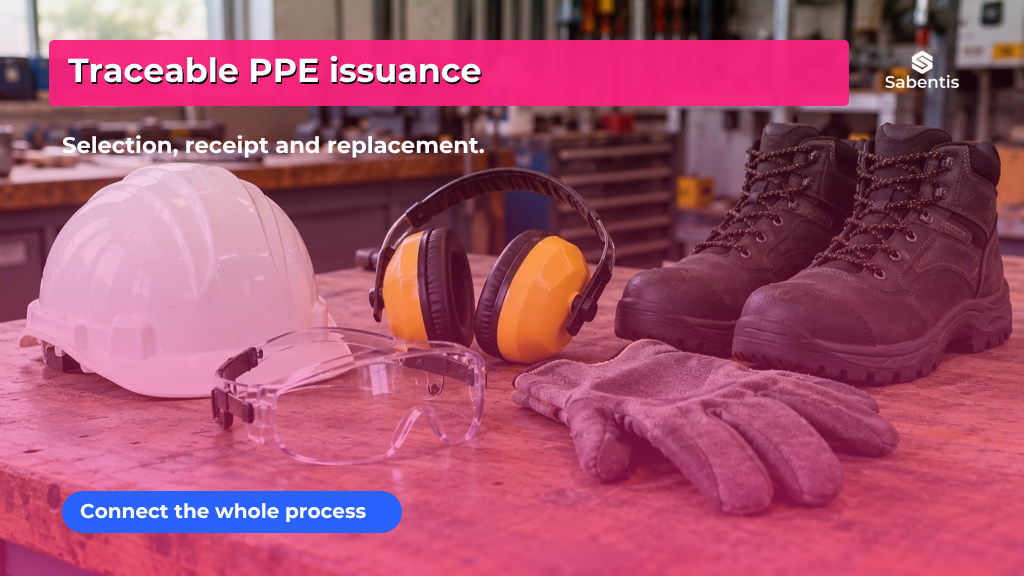
A receipt shows that an issue was recorded, but it does not explain why that PPE was selected, whether it suits the task or when it needs review. Managing the full cycle requires links between technical selection, the user, use and replacement. Software can help maintain those connections.
In Spain, Royal Decree 773/1997 (in Spanish) covers PPE selection, free provision, use and maintenance, and places its use against risks insufficiently controlled by other measures. Recording issue is one part of that preventive process.
Link equipment to a need
Before creating a product catalogue, identify the tasks and risks requiring protection. The entry on personal protective equipment explains general criteria. In operational records, link each selection to the assessment and intended conditions of use.
Distinguish an equipment category, an approved model and an individual item where traceability requires it. Products with the same general name do not necessarily offer the same performance. The purchasing reference should match the validated selection, particularly when stock shortages lead to substitution.
Prepare an issue record that can be checked
The record should show what was issued, to whom, when and for which task. Include size or fit where relevant, quantity, model and associated documentation. When an item has individual identification, preserve that reference through inspection and withdrawal.
| Stage | Information to connect |
|---|---|
| Selection | Risk, task, performance and technical validation. |
| Issue | Person, equipment, date, quantity and receipt. |
| Use | Necessary instructions, information and training. |
| Inspection | Observed condition, applied criterion and decision. |
| Replacement | Reason, withdrawn item and new issue. |
The process should accommodate problems: an item that does not fit, a product different from the one requested or damaged equipment. A signature should not close these situations before resolution. Allow the discrepancy to be recorded and sent to someone authorised to decide.
Connect receipt with information and learning
The person needs to understand when to use the equipment and how to care for it. Connect issue to relevant instructions and the OSH training appropriate to its use. Attaching a lengthy manual should not be the sole response to a practical learning need.
During a demonstration, check how delivered information is evidenced and outstanding training is handled. The job-based training matrix can show this relationship without confusing equipment receipt with competence validation.
An example of informed replacement
In an illustrative case, a worker reports damaged safety glasses. The request is linked to the assigned model and intended use. The owner checks the issue, arranges a suitable replacement and records what happens to the withdrawn equipment.
If damage recurs, the information supports a review of storage, cleaning, working conditions or model suitability. The aim is not to delay necessary replacement, but to understand the problem. Comparing consumption without that context can lead to poor decisions.
Configure dates for each type of equipment
Do not assign one expiry rule to all PPE. Review manufacturer instructions, use conditions, storage and applicable requirements. Distinguish a planned inspection date from product expiry. The system should allow the basis for each control to be recorded.
Test a model substitution, an individual’s job change and an item’s withdrawal. Check that histories remain intact and that a catalogue amendment does not retrospectively change what was issued months earlier.
Also test a failed issue: the intended model is unavailable and no approved alternative has been selected. The workflow should make the unresolved need visible and identify the decision owner. Treating stock availability as equivalent to technical suitability would break the connection with the original risk assessment.
Evaluate the complete workflow
A useful test covers selection, request, approval, issue, a reported problem and replacement. Include both the worker and the staff distributing equipment. Their time, devices and access to information determine whether records are maintained during real operations.
Connect identified problems to corrective action follow-up and review adoption by supervisors and workers. When exploring Sabentis, request a demonstration of this cycle and confirm the specific scope of PPE management for your organisation.
Checklist for identifying PPE supply problems
Review a sample of issues with the people receiving and distributing equipment. Look for situations where the record appears complete but the worker still lacks suitable protection for the task they are expected to perform.
- Select a combination of PPE worn together and check that its selection has considered compatibility and fit for the user.
- Compare the received model with the approved reference, particularly where purchasing has accepted a substitution or changed supplier.
- Identify items rejected because of size, fit or defects and confirm that reports do not show those needs as resolved.
- Check that a withdrawn item cannot be reissued merely because it remains available in inventory or retains an old label.
- Review a repeated replacement to identify selection, use or storage problems that may need an additional preventive measure.
Frequently asked questions
Does a signed receipt prove that the PPE is suitable?
It demonstrates receipt under the documented conditions, but does not replace technical selection or checking fit. Preserve the link between task, risk, model and instructions. A problem reported by the person should remain visible and be resolved even when the issue record already contains a signature.
Does CE marking allow any model to be chosen for the same risk?
No. Performance, conditions of use, fit and compatibility with other equipment still need review. Marking does not replace selection for a particular task. Ask competent personnel to validate alternatives and avoid automatically treating a commercial substitute as providing equivalent protection in the actual working conditions.
Can one replacement interval be set for every worker?
A common rule may help organise reviews, but should account for the equipment and actual conditions of use. Distinguish wear, damage, expiry and planned inspection. An administrative date should not prevent replacement of PPE that no longer provides the protection required for the task.
How should PPE used by more than one person be managed?
First establish whether shared use is permissible and which measures are needed to prevent health or hygiene problems. Record allocation, cleaning and inspection where appropriate. Do not treat a user change as a simple stock issue without checking the equipment’s condition and how it will be used.
Legislation and consulted sources
- Royal Decree 773/1997. Spain: PPE selection, use, maintenance, information and related duties. Spanish text.
- INSST technical guide on PPE use. Spain: non-binding technical guidance for applying the decree, including selection and use; distinguishes legal duties from technical guidance. Spanish text.
Sources consulted on 6 October 2026.