From FURAT to action closure: connecting accident reporting and investigation in Colombia

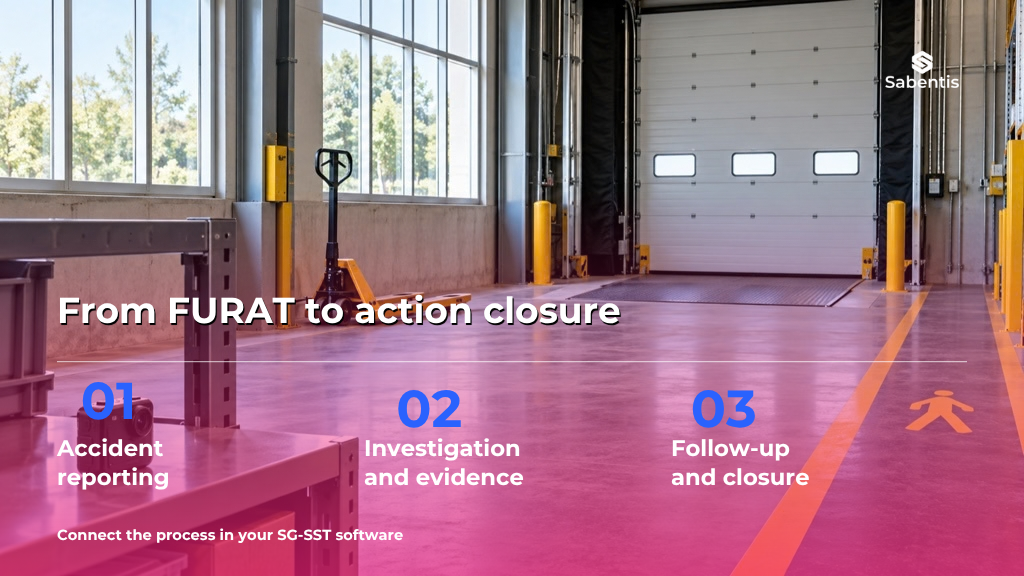
Reporting an accident and learning from it are connected processes that produce different evidence. FURAT captures information for the report; the investigation examines what happened and why; corrective actions seek to prevent recurrence. A well-organised digital case makes it possible to follow all three stages without losing records or confusing their status.
Within Colombia’s SG-SST, designing this journey requires clear responsibility for each obligation, the channel used and the evidence retained after submission. A form saved in the company’s software does not demonstrate that it has been submitted to its intended recipient.
Separate reporting, investigation and follow-up
Resolution 156 of 2005 regulates accident reports to the ARL and EPS, with a general two-working-day deadline. For serious and fatal accidents, Decree 1072, article 2.2.4.1.7, also requires direct reporting to the territorial authority within two working days.
Resolution 1401 of 2007 requires incident and accident investigation within fifteen days of occurrence. Recipients, investigation-team requirements and specific submissions need checking for each case. The system requires separate tasks for each obligation, so reporting starts without waiting for the investigation to finish.
Establish a reliable chronology from the start
Assisting people and controlling the hazard take priority. Once information can be recorded, distinguish the event date, the date it became known, the recording time and the communication dates. These references allow the sequence to be reconstructed and subsequent corrections to be explained.
Record observed facts and avoid treating first impressions as definitive causes. Information that has not yet been confirmed should retain that status until reviewed. The Explore entry on occupational accident reporting provides context for this documentary traceability and the need to distinguish records from formal submissions.
Keep the receipt with the submitted content
Associate each submission with its recipient, channel, date, version and acknowledgement or registration number. If a form is corrected, retain what changed and the resulting communication. A generic “sent” status is insufficient when there are several recipients, different responses and outstanding requests for additional information.
Before procuring software, establish which parts it actually performs: preparing data, generating files, organising documents or connecting with another organisation. Integration with an ARL must be demonstrated within its specific scope. It should not be assumed merely because the platform can attach a FURAT or store a registration number.
Investigate using connected evidence
The investigation team needs access to accounts, site conditions, instructions, controls and relevant changes. Workplace accident investigation seeks to understand causes so prevention can improve. Organising material by source and date makes comparison easier while preserving where each item came from.
For example, imagine an incident during a delivery in a loading area. The initial information points to a manoeuvre, but review may also reveal limited visibility, a changed route and inadequate communication. This illustrative scenario shows why the record should not settle on an individual explanation before examining how the work was organised.
Assign measures and check their effect
Each measure should identify the cause it addresses, the implementation owner and the evidence that will demonstrate delivery. If a route is changed, verification should observe its use; an isolated photograph of a new sign may be insufficient. Also define which changes would trigger reconsideration of the solution.
Keep a connection between the investigation report, the corrective action and verified closure. Findings may change assessments, training or instructions. Follow-up through the COPASST brings workers’ perspectives into the process and helps establish whether the proposed measure is practical in normal operations.
Test a complete case
Use an anonymised example to assess permissions, documents, versions, deadlines and alerts. Check how a corrected submission can be retrieved and what a person sees when their only task is implementing a measure. Restrict access to personal or health information according to the relevant responsibilities, including any external participation.
When assessing Sabentis for OSH management, ask to follow the case through final verification. The test should show how the information remains connected and how formal reporting duties stay distinct from the preventive work that follows, with sufficient evidence to understand both.
Consistency checks for a FURAT case file
A short comparison between documents can reveal incompatible descriptions of the same event. The aim is to clarify differences using their sources, without forcing every record to repeat an initial account that later proved incomplete or inaccurate.
- Compare date, location and activity across the report, investigation and actions, distinguishing justified corrections from ordinary errors.
- Check that each receipt is linked to its recipient and to the exact content submitted through that channel.
- Separate confirmed facts, pending information and investigation conclusions so that a hypothesis is not reused as a certainty.
- Review cover for the reporting owner and the availability of essential information while that person is absent.
- Select a closed measure and verify that its effectiveness check addresses the cause identified in the investigation report.
Frequently asked questions
Does FURAT establish the causes of an accident by itself?
The report records information about the event; the investigation must examine it and analyse the conditions that made the event possible. Keep both records linked and support later conclusions with their evidence, without turning the initial description into a definitive explanation of the cause.
Can the investigation start before every reporting detail is complete?
Organise the two activities in parallel according to the applicable obligations. Collecting preventive information should not be blocked by a missing administrative detail. Establish who confirms that detail, who continues the analysis and how any necessary corrections will be communicated through the relevant process.
What demonstrates that a communication has actually been submitted?
The case should retain the submitted content and the corresponding evidence from the channel used, including recipient and date. An internal sent flag may describe only a user action. Check which evidence establishes submission and reveals subsequent returns or requests for additional information.
How can accident lessons be shared without disclosing personal details?
Prepare a summary focused on the task, the factors identified and the measures adopted. Consider whether combinations of location, date and other details unnecessarily identify someone. Operational learning can be circulated with a different information scope from the complete investigation case file.
Legislation and sources consulted
- Resolution 156 of 2005: Colombia: the form and rules for occupational accident reporting.
- Resolution 1401 of 2007: Colombia: incident and accident investigation, including responsibilities and report contents.
Sources consulted on 6 October 2026. The practical checklist proposes management checks; its application should reflect each organisation’s scope.