Summary
- Occupational biomechanics tackles WMSDs, one of the biggest silent costs of work: pain, functional limitation, sick leave, relapses and long-term loss of capacity.
- Prevention improves when we move from general assessments to the objective measurement of real movement and effort.
- Occupational biomechanics makes it possible to quantify physical exposure and validate improvements before and after, at the workstation and in the real task.
- Sensors and wearables are accelerating the shift toward a more dynamic ergonomics: real exposure, fatigue, comparisons and follow-up.
- The ultimate goal is not to measure: it is to decide better on the basis of evidence, reduce risk and protect quality of life.
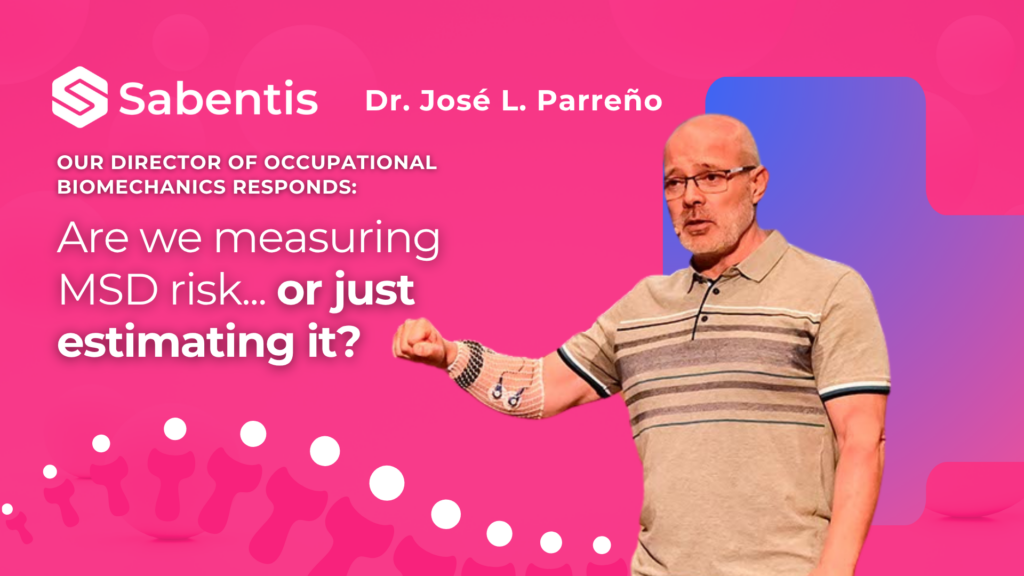
1. Are we measuring WMSD risk… or only estimating it?
For years, ergonomics has worked with tools that are very useful for identifying risk. But the reality of many jobs requires us to go one step further.
These tools are widely used to assess ergonomic risks in the workplace.
When we talk about WMSDs, what matters is not only recognising that a workstation is demanding. What matters is answering questions such as:
- which part of the body is actually most exposed?
- when does the peak demand occur within the cycle?
- is there enough recovery, or is it sustained load?
- what changes when the pace increases or fatigue sets in?
This is where occupational biomechanics comes in: it makes it possible to measure precisely how the body behaves during real work, not just to describe it.
At a picking station, the task seems reasonable: moderate weight, steady pace.
But when it is measured, repeated shoulder elevation, sustained trapezius activation and poor recovery are observed.
In WMSD prevention, that nuance changes everything.
This is critical for preventing musculoskeletal disorders over time.
Conventional observational techniques have key limitations: subjectivity and the absence of quantitative real-time data; this is why improved biomechanical assessment tools are needed.1
Babangida, A. A. et al. Advancing Occupational Medicine through Wearable Technology. ACS Sens. 2025, 10, 5410–5432. doi.org/10.1021/acssensors.5c01578
Work-related musculoskeletal disorders significantly affect quality of life, and wearables make it possible to measure exposure continuously, reliably and non-invasively.2
Sabino, I. et al. Application of wearable technology for the ergonomic risk assessment of healthcare professionals. Int. J. Industrial Ergonomics 100 (2024). doi.org/10.1016/j.ergon.2024.103570
The new prevention is not based on describing risk: it is based on measuring it in real time and turning it into operational decisions.3
Patel, V. et al. Trends in Workplace Wearable Technologies and Connected-Worker Solutions. Adv. Intell. Syst. 2022, 4. doi.org/10.1002/aisy.202100099
2. What does occupational biomechanics add compared with a conventional assessment?
It adds something essential: the real magnitude of exposure, and not just its presence.
Biomechanics makes it possible to quantify:
- real time spent in critical postures,
- effective repetition per unit of time,
- asymmetries and compensations,
- sustained muscular demand and peaks,
- changes as fatigue accumulates.
This turns ergonomics into a more objective process, because risk no longer depends so heavily on interpretation and starts to rely on comparable indicators.
This is the leap enabled by ErgoSensorIA and AI-driven ergonomic analysis.
An upper-limb exoskeleton is introduced.
Without measurement, it seems obvious that overhead work will be less demanding.
With biomechanics it is objectively shown that, above roughly 120º of arm elevation, the trapezius works harder than without the exoskeleton, because the support system hinders scapular rotation.
Wearables make it possible to measure and monitor ergonomic parameters in real time with greater accuracy and reliability than conventional methods based on observation or video.4
It reflects how sensors are revolutionising occupational risk prevention.
Stefana, E. et al. Wearable Devices for Ergonomics: A Systematic Literature Review. Sensors 2021, 21, 777. doi.org/10.3390/s21030777
3. When does it make sense to carry out a biomechanical study at a workstation?
It makes sense when the organisation needs a leap in clarity in order to decide, for example:
- there are recurring WMSDs, persistent discomfort or relapses,
- measures have been applied, but there is no real improvement,
- the risk exists, but the mechanism is not clear,
- a task needs to be redesigned or an investment justified,
- there is a wish to act before the WMSD appears.
The important point is that biomechanics is not only useful for the problem. It also serves a more preventive and strategic purpose: preserving functional capacity and quality of life.
A company introduces a change of method to reduce lumbar flexion.
Biomechanics confirms that flexion decreases… but more repeated twisting appears.
Without data, that side effect would go unnoticed.
4. How does occupational biomechanics help to design a task better and reduce risk?
Biomechanics applied to the workstation does not end in results. It ends in design decisions.
The most frequent improvements rely on:
- heights, distances and layout,
- task sequence and cycle,
- reduction of reaches and extreme postures,
- supports and tooling,
- organisational adjustments (rotation, breaks, pace).
The goal is for work to be more sustainable, with less accumulated exposure.
In a manual handling operation, a support is added that reduces trunk flexion, but increases shoulder elevation because of the height of the element.
Biomechanics makes it possible to detect that shift in risk and adjust the design so that the improvement is global, not partial.
5. How can biomechanics help to choose one tool over another?
This point usually has an immediate impact, because it turns everyday choices (tools, handles, gloves, manual or assisted systems) into evidence-based decisions.
A/B scenarios can be compared, observing differences in:
- grip force,
- muscular demand,
- posture,
- transmitted vibration,
- repetition.
Two screwdriving tools have a similar price.
One requires greater grip force and produces more sustained pronation and more vibration. The other reduces those factors.
Biomechanics makes it possible to justify that they are not equivalent, because they do not impose the same demand.
This approach has an important effect: the worker does not adapt to the tool; the tool is selected to fit the worker and the task better.
6. How does biomechanics validate whether a corrective measure really works?
This is where its greatest value for prevention appears: demonstrating that the intervention reduces risk.
Because an implemented measure is not always an effective measure. And in WMSDs, success is not measured by intention, but by a real reduction in exposure.
Biomechanics makes it possible to compare before and after:
- same task, same worker, same environment,
- equivalent indicators,
- and quantifiable conclusions.
Typical validation examples: tool A vs tool B, support yes/no, change of height, sequence redesign, rotation or micro-breaks.
This turns ergonomics into something far more defensible: prevention is governed with data.
Wearable sensing improves exposure assessment and makes it possible to detect real changes after implementing preventive measures, reducing risk misclassification.5
Lind, C. M. et al. Wearable Motion Capture Devices for the Prevention of Work-Related Musculoskeletal Disorders. Sensors 2023, 23, 4259. doi.org/10.3390/s23094259
2026 trend: wearables and sensors
Wearables are driving a relevant shift: moving from one-off measurements to more representative analysis.
They make it possible to:
- measure real exposure across the shift,
- detect peaks and critical moments,
- observe progressive fatigue,
- compare shifts and scenarios.
A task behaves well during the first few minutes, but by the end of the shift compensations appear and muscular effort increases to achieve the same result.
That pattern is fatigue, and fatigue is a multiplier of WMSD risk.
Conclusion
Occupational biomechanics does not compete with prevention: it reinforces it. Because it makes it possible to:
- measure real exposure,
- design more precise improvements,
- choose tools on objective criteria,
- and validate interventions before and after.
In WMSD prevention, this means something very concrete: → less discomfort, fewer relapses, more sustainable work and better quality of life, now and in the future.
Quantitative instrumental measurement provides a more accurate representation of exposure and makes it possible to personalise ergonomic interventions to prevent WMSDs.6
Motta, F. et al. The Use of Wearable Systems for Assessing Work-Related Risks Related to the Musculoskeletal System. Int. J. Environ. Res. Public Health 2024, 21, 1567. doi.org/10.3390/ijerph21121567
WMSD prevention is evolving toward a data-based model: measuring real exposure with sensors, deciding on evidence and validating before and after which improvements truly work.
Implementing biomechanics helps to achieve:
Frequently asked questions
What is the difference between a conventional ergonomic assessment and a biomechanical study?
When is it worth applying occupational biomechanics?
Can it be measured at the actual workstation, or is a laboratory needed?
Are wearables reliable for assessing WMSD risk?
How do you demonstrate that a corrective measure works?
Scientific references
- Babangida, A. A. et al. Advancing Occupational Medicine through Wearable Technology: A Review of Sensor Systems for Biomechanical Risk Assessment and Work-Related Musculoskeletal Disorder Prevention. ACS Sens. 2025, 10, 5410–5432. https://doi.org/10.1021/acssensors.5c01578
- Sabino, I. et al. Application of wearable technology for the ergonomic risk assessment of healthcare professionals: A systematic literature review. Int. J. Industrial Ergonomics 100 (2024). https://doi.org/10.1016/j.ergon.2024.103570
- Patel, V. et al. Trends in Workplace Wearable Technologies and Connected-Worker Solutions for Next-Generation Occupational Safety, Health, and Productivity. Adv. Intell. Syst. 2022, 4. https://doi.org/10.1002/aisy.202100099
- Stefana, E. et al. Wearable Devices for Ergonomics: A Systematic Literature Review. Sensors 2021, 21, 777. https://doi.org/10.3390/s21030777
- Lind, C. M. et al. Wearable Motion Capture Devices for the Prevention of Work-Related Musculoskeletal Disorders in Ergonomics: An Overview of Current Applications, Challenges, and Future Opportunities. Sensors 2023, 23, 4259. https://doi.org/10.3390/s23094259
- Motta, F. et al. The Use of Wearable Systems for Assessing Work-Related Risks Related to the Musculoskeletal System: A Systematic Review. Int. J. Environ. Res. Public Health 2024, 21, 1567. https://doi.org/10.3390/ijerph21121567

Digitalisation, compliance, prevention and applied intelligence for OHS.