AI and prevention: the human judgment no technology can replace
Artificial intelligence in occupational health and safety can already read entire case files, connect data that spent years in separate silos and propose priorities in seconds. The question that matters is not whether it will reach the OHS department. It is already inside. The question is which decisions it can take on its own, and which ones it should never take without a person in front of it.
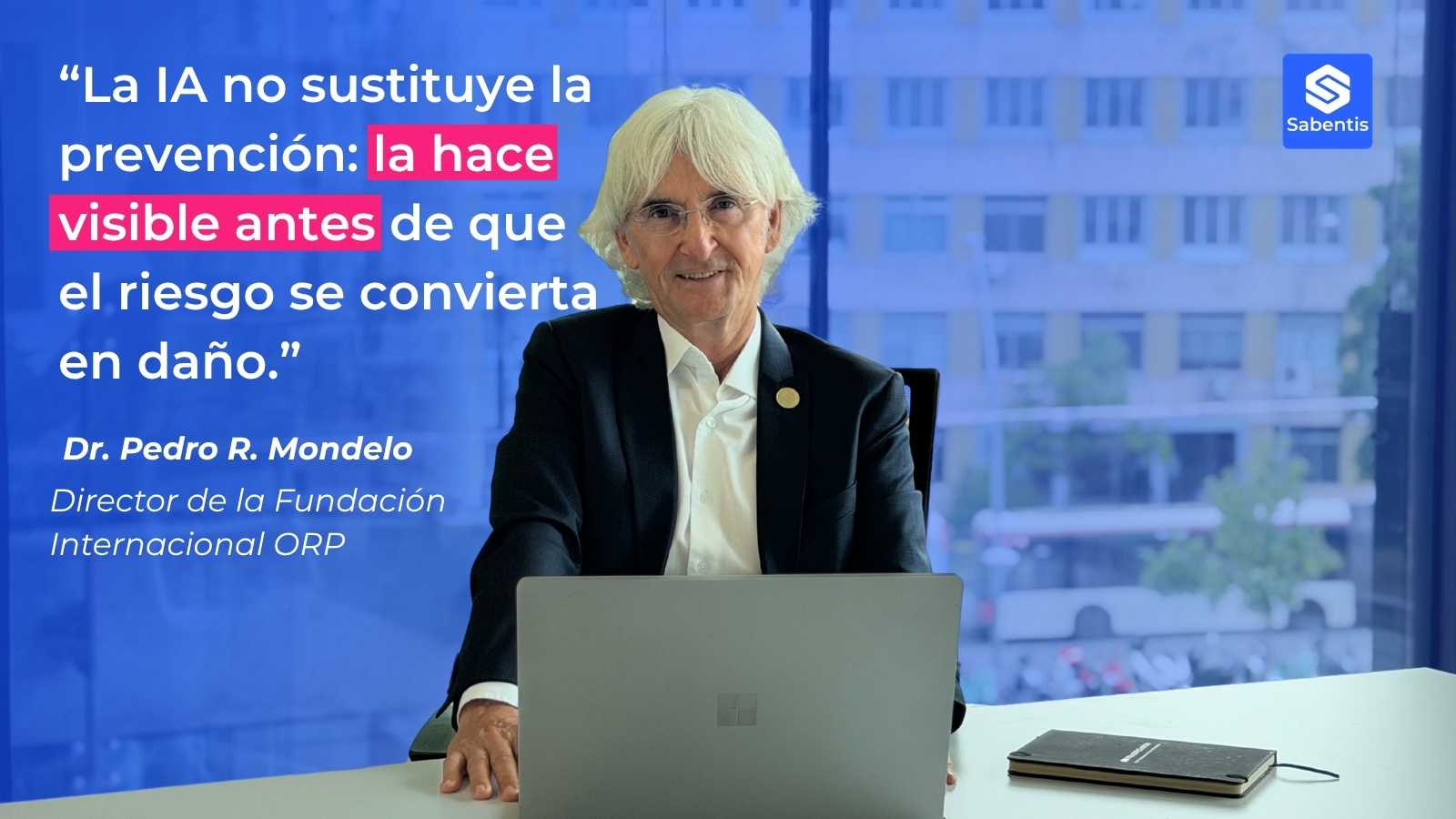
“In prevention I have seen many technologies arrive. None with this much potential. And none demanding this much judgment.” The words belong to Dr Pedro R. Mondelo, director of the ORP International Foundation and Chancellor of Carver University for Ibero-America. Forty years of working precisely where technology, organisation and human behaviour meet teach you to recognise a boundary when you see one.
It is worth hearing it from him before going any further. In this talk at LEAN ORP 2026, Pedro R. Mondelo explains why the data an organisation cannot read may end up costing it dearly. The video is in Spanish, and it lands exactly where this article does: where artificial intelligence helps, and where judgment has to take over.
Short answer. No, artificial intelligence does not replace the OHS professional. It can gather scattered information, detect patterns, draft documents and trigger early alerts. It cannot understand real work, decide which risk is acceptable or answer to a health and safety committee. AI extends the capacity to observe; responsibility remains human, and since 2024 European law expects exactly that.
What artificial intelligence can already do for occupational health and safety
It is worth starting with the concrete. These five capabilities are available today, not on a roadmap.
1. Organising and connecting information that has been scattered for years
Over decades, an organisation accumulates risk assessments, incident investigations, inspections, corrective actions, training records, preventive observations, health indicators and contractor documentation. When all of it lives in different folders, the professional spends most of the time searching and the least of it interpreting.
AI reverses that ratio: it classifies, summarises and connects. The condition is not minor: it must work on authorised sources, quality data and properly defined permissions. On a disordered repository, the only thing that accelerates is error. That is why treating data as the operating system of the OHS management system is the step before, not after.
2. Detecting weak signals and helping to prioritise
By analysing historical records, AI identifies repetitions, deviations and combinations of factors that do not stand out to the naked eye. It points to where incidents concentrate, which actions have been open too long or which units show indicators worth a visit.
This is not “predicting accidents”. A statistical pattern is a signal to investigate, not a causal explanation, and certainly not an automatic verdict on a team or a shift. Confusing correlation with cause is the most expensive mistake these tools invite.
3. Giving back hours of administrative work
Preparing drafts, summarising files, comparing legal requirements, structuring reports, ordering evidence or retrieving precedents are tasks where AI saves real time. The value is not producing more documents: it is freeing professional capacity to go down to the floor, talk to the people who do the work and decide better.
4. Bringing preventive knowledge closer to the people who need it
An assistant integrated in the OHS management platform can locate a procedure, explain a concept, guide a query or adapt material to different profiles and languages. A generated answer is only useful if it rests on current information, shows where it comes from and can be reviewed before it becomes a binding instruction.
5. Anticipating instead of reacting
The combination of structured data, sensors, analytics and AI makes early-warning systems and trend monitoring possible. It is the shift from a prevention that reacts once harm has occurred to a management approach that detects the signs of deterioration earlier. It is also the ground where the Sabentis AI Agents (in Spanish) operate: they have been running for some time, so far internally and in controlled pilot projects with a number of companies, always under human oversight.
Anticipation, however, does not remove uncertainty. AI widens the capacity to observe. It does not turn the future into a certainty.
What AI cannot do: the judgment that remains human
Here is the part no vendor has much incentive to spell out. These five functions do not get automated, and not because of a passing technical limitation.
Understanding real work, not the written procedure
Data describes part of the activity. To understand why a task is done a certain way you have to observe it, talk to the people who perform it, know the production constraints and distinguish the written procedure from work as it actually happens. That distance between the prescribed and the real is where most accidents live, and it appears in no database.
Deciding which risk is acceptable
A tool can rank alternatives. It cannot decide on its own which risk is tolerable, which measure is proportionate or what comes first when the budget does not stretch to everything. That decision demands technical knowledge, organisational context and someone willing to sign it.
Listening and guaranteeing participation
Worker consultation and participation cannot be reduced to automated data extraction. Prevention needs dialogue, trust and a real possibility of challenging a conclusion. A system that only measures behaviour without listening to anyone is not doing prevention: it is doing surveillance.
Taking responsibility
An algorithm does not sign a risk assessment, does not appear before the health and safety committee, does not explain a decision to an affected person and does not answer for the consequences of a wrong measure. Professional and organisational responsibility remains human, and the law takes that for granted.
Setting limits on the system itself
Deciding which data is collected, for how long, for what purpose and who can access it is a governance decision, not a configuration setting. So is determining when a recommendation requires mandatory review, which uses are prohibited and how bias, errors and misuse are detected.
| AI can help to… | The person must… |
|---|---|
| Detect a correlation | Investigate whether there is a cause and understand the context |
| Prioritise signals | Decide which action is necessary and proportionate |
| Generate a draft | Verify it, correct it and approve it |
| Summarise a case file | Check that nothing relevant has been left out |
| Propose measures | Validate their feasibility and their impact on real work |
| Trigger an alert | Decide how to intervene and take responsibility |
What European law requires when AI enters people management
This is the part that moves the conversation from “good practice” to “obligation”. Regulation (EU) 2024/1689, known as the EU Artificial Intelligence Act, classifies as high-risk in its Annex III the systems used in the workplace for two purposes:
- Recruitment and selection: placing targeted job advertisements, analysing and filtering applications, and evaluating candidates.
- Decisions on the employment relationship: promotion or termination, task allocation based on behaviour or personal traits, and monitoring and evaluating the performance and behaviour of workers.
That last point lands squarely on prevention. A system that monitors safe behaviours, scores preventive observations or evaluates how a team performs can fall into the high-risk category, with everything that entails: data governance, technical documentation, event logging, transparency towards the people affected and, explicitly, effective human oversight.
On the timeline it pays to be precise, because it changed very recently. The transparency obligations have applied since 2 August 2026. The obligations for Annex III high-risk systems have been deferred: the Digital Omnibus on AI was published in the Official Journal of the EU on 24 July 2026 and entered into force on 27 July 2026, moving that date to 2 December 2027.
The deferral is not a moratorium on judgment. It is time to do properly what will have to be demonstrated anyway: knowing which data feeds the system, who reviews its outputs and who answers for them. Organisations already working that way will arrive without surprises. Those who wait until 2027 will have to rebuild traceability backwards, which is always the most expensive way to do it.
The risk of automating without judgment
A poor AI deployment manufactures a false sense of objectivity. If the input data is incomplete, so is the result, only better presented. If the system reproduces historical bias, it turns it into apparently neutral recommendations. And if nobody understands how an output was produced, nobody will be able to question or correct it.
The workplace adds its own specific risks: excessive surveillance, loss of autonomy, work intensification, health data used beyond its purpose, errors that fall unevenly on different groups, and dependence on tools the team does not know how to supervise.
The European Agency for Safety and Health at Work insists on a human-centred approach: early worker participation, clear communication and an adapted approach to managing prevention. It is not enough for a technology to work. It must improve work without introducing a new risk larger than the one it solves.
Five questions before bringing AI into prevention
Before deploying any system, an organisation should be able to answer clearly. If a single one fails, it is not the moment yet.
- Which specific preventive problem do we want to solve? AI is not deployed out of fashion or as a generic solution. If the answer is “to innovate”, there is no project.
- Which data does it use, and of what quality? Origin, currency, integrity, permissions and known biases. All of it in writing.
- What can it do autonomously and what requires validation? The limits are defined before using it, not after the first error.
- Who supervises and answers for the result? Every output that influences health or safety needs an identifiable person responsible for it.
- How will we know whether it actually improves prevention? Success is measured in better decisions and better preventive outcomes, not in the number of texts, alerts or analyses generated.
Who is Dr Pedro R. Mondelo
The weight of this warning about AI does not come from any rejection of technology. It comes from decades of working exactly where technology, organisation and human behaviour meet.
It is also the outlook he takes on stage. Under the motto “At work: One life, one planet” of the ORP International Foundation, Mondelo delivers the lecture “El trabajo que (no)s espera” (The work that awaits us, or does not), where he raises the same dilemma that runs through this article: which part of work makes sense to delegate to a machine, and which part we should never delegate at all.
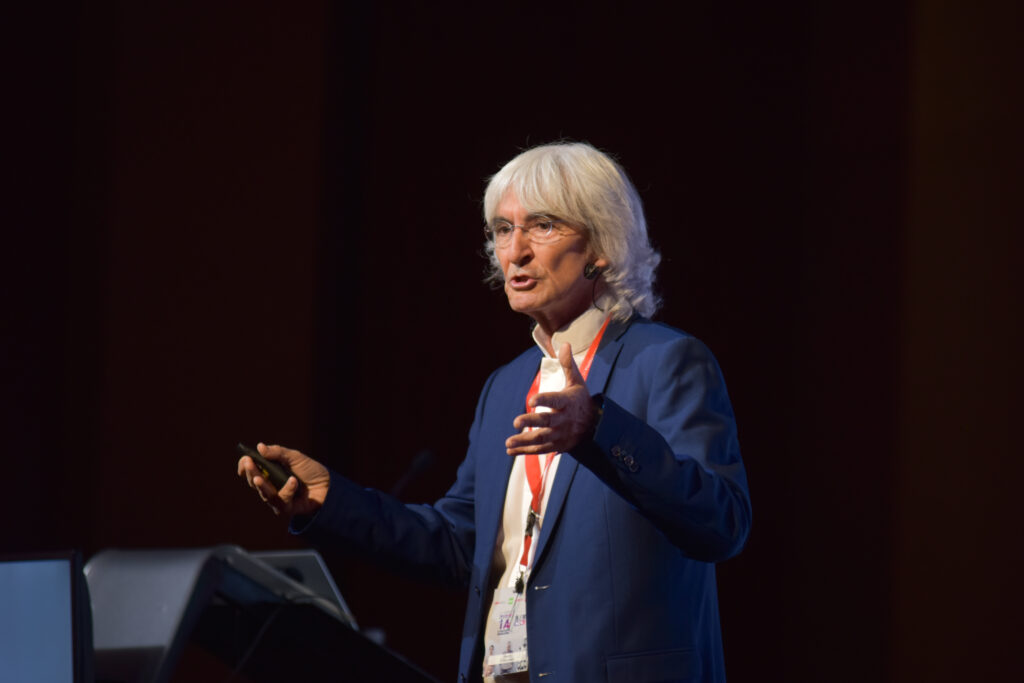
Pedro Manuel Rodríguez Mondelo holds a doctorate in industrial engineering from the Universitat Politècnica de Catalunya, with a thesis on transgenerational ergodesign awarded cum laude by unanimity, and a doctorate in Psychology from the Universitat de Barcelona, also cum laude by unanimity, with research on ergonomics and the working conditions of teaching staff. He also holds degrees in Psychology and in Educational Sciences, a master in Industrial Risk Management from the UPC, and certification as a European Ergonomist by the Centre for Registration of European Ergonomists.
Academic career
He developed a significant part of his academic career at the Universitat Politècnica de Catalunya, where he taught at the Escola Tècnica Superior d’Enginyeria Industrial de Barcelona and the Escola Politècnica Superior d’Edificació de Barcelona. His university work focused on ergonomics, prevention and the education of occupational health and safety professionals.
Over his career he directed the CERpIE at the UPC, the Research and Development Centre for Ergonomics and Occupational Risk Prevention at the ETSEIB, the Mutual Cyclops-UPC Chair, the Escola Superior de Prevenció de Riscos Laborals and the doctoral programme in Ergonomics and Work Sciences. He has supervised dozens of theses and projects on physical and mental workload, ergonomic assessment methods, workplace design, accessibility, manual handling and preventive management systems.
Research, tools and transfer
His research has covered ergonomics and human-centred design, musculoskeletal disorders and physical workload, mental workload and psychosocial factors, occupational road safety, management system audits, absenteeism, nanosafety and emerging risks, accessibility and transgenerational design. He has led studies for Spain’s National Institute for Safety and Hygiene at Work (today INSST), the Basque Institute for Occupational Safety and Health (OSALAN), the Foundation for the Prevention of Occupational Risks and European programmes.
Together with the UPC, he holds a patent for a lifting platform designed to make rail transport accessible to people with reduced mobility. And long before anyone spoke of AI, he was already building software applied to prevention: systems to draw up self-protection plans, audit machine safety and ergonomics, assess care homes, analyse workstations and apply methods such as NIOSH, REFA or AFNOR. In 2004 he launched UPCtools, an online laboratory with 28 risk assessment tools that already generated its reports automatically from the browser, the seed of a good part of the OHS platforms we know today. That early experience in digitalising prevention explains why his current reflection is not that of a sceptic.
Publications and international standing
In September 1994, Pedro R. Mondelo published, together with Enrique Gregori Torada and Pedro Barrau Bombardó, the first edition of Ergonomía 1. Fundamentos, issued by Edicions UPC and Mutua Universal. That volume opened a series devoted to understanding and improving the relationship between people, workstations, tools and the working environment. More than three decades later, the same principle, adapting technology to people, runs through his thinking on artificial intelligence.
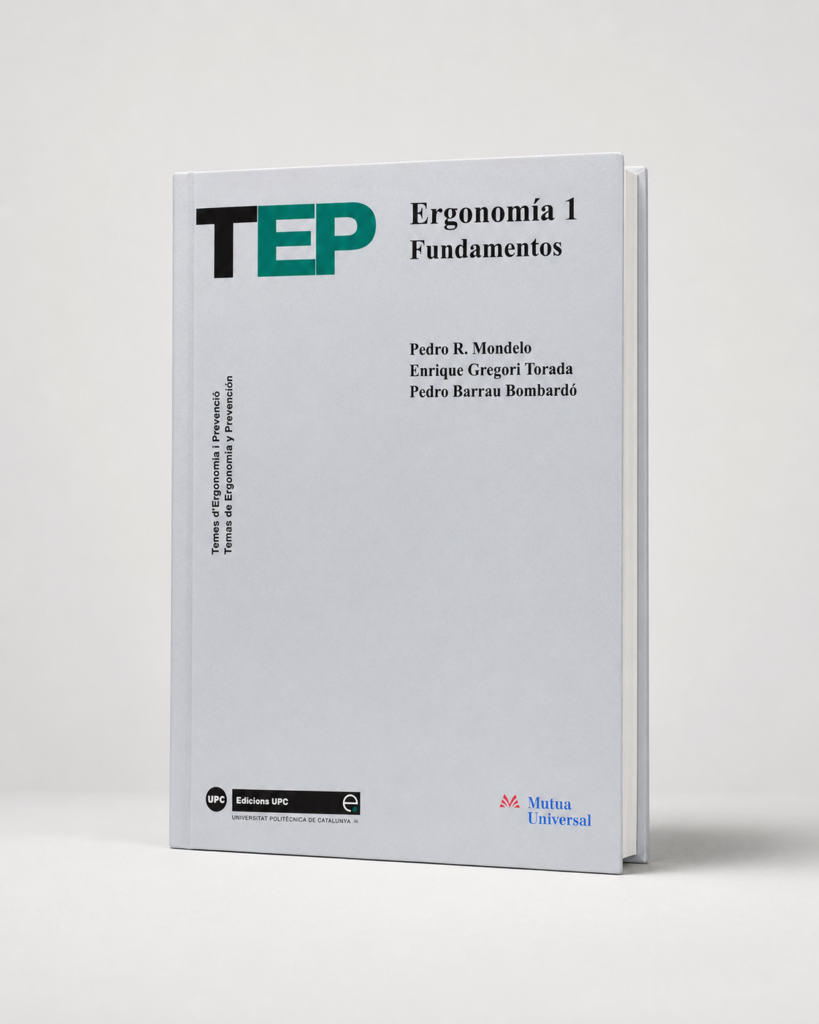
He is the author and co-author of reference works such as Fundamentos de ergonomía, Confort y estrés térmico, Diseño de puestos de trabajo, Ergonomía 4. El trabajo en oficinas, La ergonomía en la ingeniería de sistemas and Introducción a la organización del trabajo, alongside dozens of scientific publications and conference papers.
He is the founder and director of the ORP International Foundation, an independent non-profit organisation from which he has run, for decades, congresses and symposia connecting researchers, public institutions, companies and prevention professionals across Europe and Latin America, including the LEAN ORP meeting in Madrid. Carver University also presents him as its Chancellor for Ibero-America.
He has served on international scientific committees and editorial boards, including those linked to Theoretical Issues in Ergonomics Science, Human Factors and Ergonomics in Manufacturing and the International Journal of Occupational Safety and Ergonomics. He chaired the Spanish Ergonomics Association. His recognitions include a Doctor Honoris Causa from the Polytechnic and Artistic University of Paraguay, awarded in 2022.
A position held over time
His reading of AI is not new. In an interview published by the ORP International Foundation in April 2024, marking the World Day for Safety and Health at Work, Mondelo already placed the debate exactly where it belongs:
“We must turn AI to our advantage so that it gives us clues about what escapes us as humans.” And, in the same conversation: “We must start examining the ethical loose ends and reconcile them with everything that has to do with digitalisation and AI.”
Two years later, European law has turned into an obligation what he framed as professional responsibility. The full interview is available (in Spanish) at the ORP International Foundation.
From judgment to training: Sabentis Academy
Adopting artificial intelligence responsibly takes more than buying a tool: it takes people who understand how it works, what it contributes and where its limits are. That is why Sabentis has brought together in Sabentis Academy an offer that combines free practical training with university specialisation, including two postgraduate programmes from the academic ecosystem of Easy Tech Global, Carver University and the ORP International Foundation.
26 official Sabentis courses, online and free
OHS teams can train free of charge in the technology they already use. Academy offers 26 official courses, 100% online and self-paced, organised to learn the platform’s main capabilities in a practical way. On completion, participants receive a certificate from Sabentis and Carver University. You can read how Sabentis Academy came about and what it includes.
This is not generic training about artificial intelligence. It is about knowing in depth the processes and tools used to manage prevention every day, so they are used with more autonomy and better judgment.
Access the Sabentis Academy courses free of charge.
The free offer covers these 26 Sabentis courses. The two postgraduate programmes below have their own admission requirements, fees and academic conditions.
Master in Occupational Health and Safety: Prevention of Occupational Risks
The Master in Occupational Health and Safety: Prevention of Occupational Risks is aimed at professionals ready to take on senior-level responsibilities with an international, multidisciplinary and applied outlook. It is built around the four non-medical preventive disciplines: workplace safety, industrial hygiene, ergonomics and applied psychosociology, combining the scientific and technical foundations of prevention with ISO 45001, data analytics, Power BI and the impact of artificial intelligence on OHS.
It runs for 18 months, carries 70 ECTS and is delivered online, synchronously, in Spanish, with 360 hours of external placements and a final project applying everything learned.
See the programme of the Master in Occupational Health and Safety.
Master in Ergonomics and Work Management
The Master in Ergonomics and Work Management goes deep into the interaction between people, tasks, technology and working environments, integrating physiology, psychology, engineering and design. Over 18 months, with 70 ECTS, delivered online, synchronously, in Spanish, it develops competences in anthropometry, occupational biomechanics, cognitive ergonomics, physical and mental workload, workplace design and the management of ergonomic interventions, together with digitalisation and AI applied to ergonomics.
See the programme of the Master in Ergonomics and Work Management.
Technology should give time back to the OHS professional
The best AI applied to prevention is not the kind that aspires to take the professional’s place. It is the kind that gets them to the relevant information sooner, helps them understand the system better and frees more of their time for the decisions that demand presence, experience and judgment.
That is also the Sabentis approach: integrating data, processes and artificial intelligence capabilities into a single OHS management platform, with traceability and professional oversight. It is the same direction already pointed to by prevention 5.0: technology brings speed and scale, the prevention team keeps control.
Nor is it a recent position. Sabentis was the first platform to bring artificial intelligence into occupational health and safety, with a first public presentation at the ORP International Congress in April 2020, and has since built it into its workflows as a native functional layer.
Pedro R. Mondelo’s phrase sums up the challenge precisely:
“In prevention I have seen many technologies arrive. None with this much potential. And none demanding this much judgment.”
The question is no longer whether artificial intelligence will enter occupational health and safety. It is already here, and from 2027 with enforceable obligations. The question is whether organisations will use it to replace reflection with automation, or to extend, responsibly, the human capacity to protect.
Start with training: access the 26 free Sabentis Academy courses. And if you want to see how Sabentis integrates artificial intelligence into occupational health and safety management, request a free demo.
Frequently asked questions on AI and occupational health and safety
Can artificial intelligence replace the OHS professional?
No. AI can gather scattered information, detect patterns, generate drafts and trigger alerts, but it does not understand real work, does not decide which risk is acceptable and does not answer to a health and safety committee. It extends the professional’s capacity to observe; it does not take over their judgment or their responsibility.
What can AI already do in occupational health and safety?
Five things reliably: organise and connect scattered documentation, detect signals and help prioritise, reduce repetitive administrative work, bring preventive knowledge closer to the people who need it, and build early warnings from data, sensors and analytics.
Can artificial intelligence predict workplace accidents?
Not with certainty. It can identify patterns, repetitions and combinations of factors that deserve attention. A statistical pattern is a signal to investigate, not a causal explanation. Presenting a prediction as a certainty is one of the most frequent and most expensive mistakes when deploying these tools.
Is human oversight of AI mandatory in the workplace?
Yes, for systems classified as high-risk. Regulation (EU) 2024/1689 requires effective human oversight, data governance, technical documentation, event logging and transparency towards the people affected.
Is an AI system that evaluates safe behaviour high-risk?
It can be. Annex III of the EU AI Act includes among high-risk systems those intended to allocate tasks based on behaviour and to monitor and evaluate the performance and behaviour of workers. Many preventive observation tools fit that description.
When do the obligations for high-risk AI systems apply?
The transparency obligations have applied since 2 August 2026. Those for Annex III high-risk systems were moved to 2 December 2027 by the Digital Omnibus on AI, published in the Official Journal of the EU on 24 July 2026 and in force since 27 July 2026.
What data does AI need to be useful in prevention?
Data of known origin, current, complete, with defined permissions and with its biases identified. On a disordered repository AI adds no judgment: it accelerates error and gives it an appearance of objectivity.
Where can I get trained in AI applied to occupational health and safety?
Sabentis Academy offers 26 official free courses, 100% online and self-paced, on the Sabentis platform, with a certificate from Sabentis and Carver University. For university-level specialisation there are the Master in Occupational Health and Safety and the Master in Ergonomics and Work Management, both taught in Spanish and covering digitalisation and applied AI.
Sources
- European Commission. AI Omnibus enters into force (July 2026).
- Annex III of Regulation (EU) 2024/1689: high-risk AI systems, point 4, employment and worker management.
- Revolutionizing health and safety: the role of AI and digitalization at work, International Labour Organization.
- Digitalisation of work, European Agency for Safety and Health at Work.
- Interview with Pedro R. Mondelo on ethics, digitalisation and AI (in Spanish), ORP International Foundation, April 2024.
- Profile of Pedro Manuel Rodríguez Mondelo at FUTUR-UPC.
- University Master in Occupational Health and Safety, UPC.
- Doctor Honoris Causa, Polytechnic and Artistic University of Paraguay.
- Carver University: academic cooperation with the ORP International Foundation.
- Sabentis Academy: free official courses and specialisation programmes.