Artificial intelligence in occupational health and safety: from automation to agentic AI
AI in occupational health and safety is no longer a promise. Artificial intelligence is already in production, and it does three different things. It automates repetitive work, it predicts where risk will concentrate and, in its most recent form, it acts. That last step is what changes the daily work of an OHS professional. And it is what separates a record-keeping tool from an intelligent prevention platform.
What AI in occupational health and safety actually adds
The starting point is uncomfortable. According to the International Labour Organization, 2.93 million workers die each year as a result of work-related factors. In addition, 395 million sustain a non-fatal work injury. Prevention built on manual inspections and document archives does not close that gap.
AI changes the order of prevention. Instead of describing what already happened, it organises what is about to happen. In other words, it moves the system from reactive to predictive. And with agents, it moves one step further, to operational.
Capabilities already in production
It is worth separating what already works in occupational health and safety from what is merely announced. These capabilities run on real data:
- Automated postural analysis: computer vision detects joints in video and calculates REBA, RULA and OWAS scores. In addition, videos are processed overnight and the report is ready in the morning.
- Accident prediction: machine learning cross-references accident history, working conditions and shifts. As a result, it ranks risk by site, job and shift.
- Corrective action drafting: generative AI writes measures, reports and action plans with tasks, deadlines and owners.
- IoT sensing: sensors measure temperature, vibration, noise and muscle activity continuously.
- Embedded BI: dashboards show frequency, severity and absenteeism. Therefore, they allow drilling from the chart down to the evidence.
- Conversational agents: the Ethos 2.1 model handles basic questions and answers about the prevention system.
- Data agents: the Magnus 4.5 model interacts with the company’s data warehouse.
The first five automate and predict. However, the last two are a different kind of thing.
Agentic AI in occupational health and safety: Ethos 2.1 and Magnus 4.5
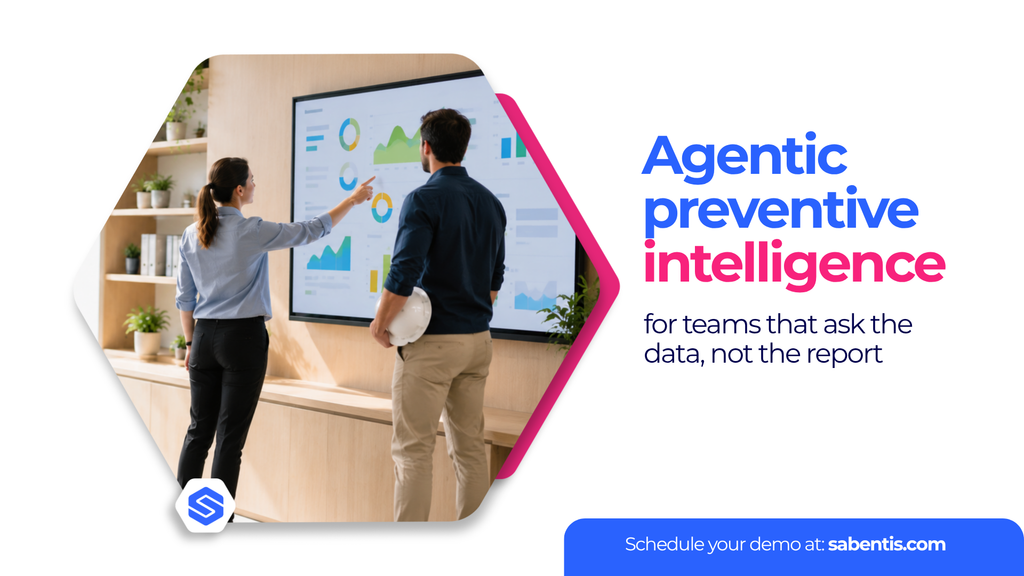
The difference between automating and acting lies in who starts the task. An automation waits for a trigger configured in advance. An agent, in contrast, interprets a request in natural language and resolves it against the data.
Sabentis builds agentic artificial intelligence in natively, with two models of different scope. Ethos 2.1 covers basic questions and answers. Meanwhile, Magnus 4.5 interacts with the company’s data warehouse. That is where the consolidated history of accidents, training, assessments and health surveillance lives.
The distinction matters in practice. Answering a procedural question is one thing. Querying consolidated data across every site, without going through an intermediate report, is another.
Architecture and security: where the data lives
An agent is only as reliable as the data governance behind it. In AI for occupational health and safety, therefore, architecture is not a technical footnote: it is part of the argument. Sabentis runs on Azure infrastructure with Kubernetes and separates access by role and by site through RBAC and RLS. In addition, it maintains ISO 27001, the Spanish National Security Framework and GDPR compliance.
Sensor integration builds on the Bosch and Sabentis Intelligence Center. And the underlying principle is the one we set out when discussing data as the nervous system of the OSH management system. Without traceability, prediction is opinion.
Automating, predicting and acting are not the same
- Automating: the system runs a repetitive task when a condition is met. Whoever configured it sets the scope.
- Predicting: the model estimates where harm is most likely to appear. However, it does nothing with that estimate.
- Acting: the agent takes a request in natural language and resolves it against the data. Therefore, the user does not need to know where the report lives.
- Deciding: this stays human. AI amplifies the professional, but the signature and the liability are not delegated.
AI software for occupational health and safety: what it should deliver
A record-keeping tool documents what already happened. An intelligent prevention platform does something else. It connects the risk assessment with training, health surveillance and incident investigation. In addition, it exposes that whole to an agent that knows how to query it. That is where loose modules differ from a system.
You can see the argument developed in OHS software as the operating system in large enterprises and the data groundwork in big data in occupational risk prevention. The ergonomics side is covered in our piece on the REBA method, and the wider debate in artificial intelligence and prevention. If you want to see it against your own data, request a demo.
Frequently asked questions
Does AI replace the occupational health and safety professional?
No. AI automates repetitive tasks, spots patterns and drafts documents. However, the decision and the liability still belong to the professional.
What is agentic AI applied to prevention?
These are models that resolve a natural-language request against the system’s own data. In Sabentis, Ethos 2.1 handles basic questions and answers. Meanwhile, Magnus 4.5 interacts with the company’s data warehouse.
What data does AI need to work in prevention?
Accident records, risk assessments, absenteeism data, workstation video, sensor signals and the organisational structure. In addition, that history has to be consolidated and permissioned by role.
Is AI safe when applied to occupational health data?
That depends on data governance, not on the model. Sabentis maintains ISO 27001, the Spanish National Security Framework and GDPR compliance, with access control by role and by site.