NIOSH equation: how to work out the recommended weight limit (with example)
Few tools in ergonomics get quoted as often as the NIOSH equation, and few get read as badly. Someone works out the lifting index, gets 1.4, and the report waves it away as moderate risk, without saying which factor caused it or which measure would fix it. The equation gives much more than that, because it points at the problem factor by factor.
This guide explains what the NIOSH equation is, how to work out the recommended weight limit (RWL) and how to read the lifting index (LI). It also clears up the cases where you should not apply it.
What the NIOSH equation is
The NIOSH equation (Revised NIOSH Lifting Equation) is the world reference method for rating the manual lifting of loads. Waters, Putz-Anderson, Garg and Fine published its revised version in 1993, together with the NIOSH user manual (paper 94-110). ISO 11228-1:2021 later brought it into its own framework. In Spain, the INSST also covers it in NTP 477.
Its logic is easy to tell. First you work out how much weight would be reasonable to lift under the real conditions of the task, which is the RWL. That value is then compared with the weight the worker really lifts, and the LI comes out of there.
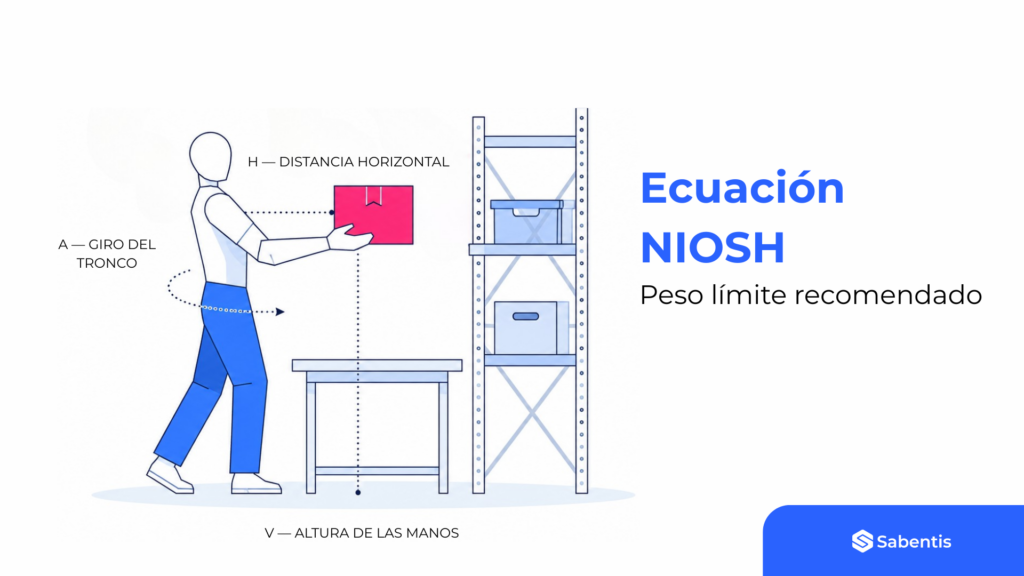
The NIOSH equation formula and its seven factors
The NIOSH equation gets the recommended weight limit by multiplying a load constant by six penalty factors, all of them between 0 and 1.
RWL = LC x HM x VM x DM x AM x FM x CM
| Factor | What it weighs | When it cuts the limit |
|---|---|---|
| LC, load constant | 23 kg as a starting point | Fixed reference value |
| HM, horizontal | Distance of the load from the body | The further from the body |
| VM, vertical | Height of the hands at the start | The further from 75 cm |
| DM, displacement | Vertical travel of the load | The longer the travel |
| AM, asymmetry | Trunk twist angle | The wider the twist |
| FM, frequency | Lifts per minute and duration | The more frequent and the longer |
| CM, coupling | Quality of the hand to load fit | Fair or poor grip |
This structure is the key to a good reading, because each factor points at a cause and also at a measure. A low HM asks you to bring the load closer to the body. A low VM asks you to raise the origin of the lift. And a low FM asks you to slow the pace or rotate the task.
What the 23 kg constant means
The 23 kg figure is neither a legal limit nor a safe weight for everyone. It is the load that the NIOSH equation treats as safe for most healthy workers, always under ideal conditions: close to the body, at the right height, with no twist, with a good grip and at a low frequency. As soon as real conditions drift from that ideal, the factors pull the limit down. That drop measures the size of the problem.
The lifting index and how to read it
The lifting index compares the real weight with the limit the NIOSH equation returns.
LI = real weight lifted / RWL
| Lifting index | Reading |
|---|---|
| LI of 1 or below | Limited risk for most workers |
| LI between 1 and 3 | Growing risk: some exposed workers may be harmed, so action is due |
| LI above 3 | High risk: the task has to change |
When the NIOSH equation does not apply
The NIOSH equation carries validity conditions that people often skip. It does not cover one handed lifting, nor lifting while seated or kneeling. The method also fails in tight spaces that force the posture, with unstable objects such as liquids, people or animals, on unsteady floors or in a very harsh setting.
Pushing, pulling and carrying fall outside it too, because the Snook and Ciriello tables handle those. And it does not replace the postural assessment of the REBA method when posture is the factor that leads.
Practical example: how a calculation is reasoned
Here is how the NIOSH equation reasons in a real case. An operator lifts 12 kg boxes from a low table up to a shelf. The load sits somewhat away from the body, the trunk twists a fair amount and there are several lifts per minute over much of the shift, with a fair grip.
The reasoning is simple: you start from 23 kg and every poor condition pulls it down. Horizontal distance is usually the worst hit factor, followed by sustained frequency and by the twist. The RWL can therefore land well below the real 12 kg, with an LI between 1 and 3, that is, growing risk and a need to act.
The breakdown also ranks the measures by impact. Bringing the origin of the load closer to the body and raising the starting plane usually win back more limit than anything else. The exact multiplier values must come from the NIOSH user manual.
Multiple tasks: the composite lifting index
When a workstation mixes several types of lift, with different origins, heights or rates, an average is worthless. For that case the NIOSH equation defines the composite lifting index (CLI), which starts from the most demanding subtask and adds the extra risk of the rest. This is where most mistakes creep in, and also where assisted calculation helps most.
NIOSH equation or the INSST Technical Guide
In Spain the two references live side by side. The INSST Technical Guide develops RD 487/1997 and is what the labour authority expects by default, with its tolerable or not tolerable result. The NIOSH equation, on the other hand, gives a finer reading factor by factor and is the world standard that ISO 11228-1 picks up.
They do not compete: the Guide covers the legal side and NIOSH sharpens the design of the measure. The full map of tools sits in the guide to ergonomic assessment methods. You can also follow the technical debate in the ergonomics section of Prevencion Integral.
Frequently asked questions
What does a lifting index above 1 mean?
It means the real weight goes past the limit recommended for those conditions. Risk grows with the value of the index, so you have to act on the worst hit factors. Above 3, the task has to change.
Is 23 kg the legal maximum in Spain?
No. It is the starting constant of the NIOSH equation under ideal conditions. The Spanish legal framework is RD 487/1997 and its Technical Guide, which uses its own values based on the task and on the workers exposed.
Does the NIOSH equation cover pushing or carrying?
No, because it only covers lifting and lowering. Pushing, pulling and carrying are rated with the Snook and Ciriello tables, inside the scope of ISO 11228-2.
How does it relate to ISO 11228-1?
The 2021 edition brings the revised equation into its lifting assessment procedure, with more examples and a wider reading. The International ORP Foundation also publishes plain language material on this framework.
From calculation to risk management
Working out an RWL properly with the NIOSH equation means measuring distances, angles and frequencies, and repeating the process in every subtask. If you want to see how load handling is managed next to the rest of the methods and their action plan, request a Sabentis demo.
Still working out the NIOSH equation by hand?
Sabentis resolves the recommended weight limit and the lifting index at every workstation, and it keeps the history of all your assessments.
Request your demoA guided 30 minute demo. No strings attached.