Climate Change and OHS: What Construction Companies Must Do Right Now

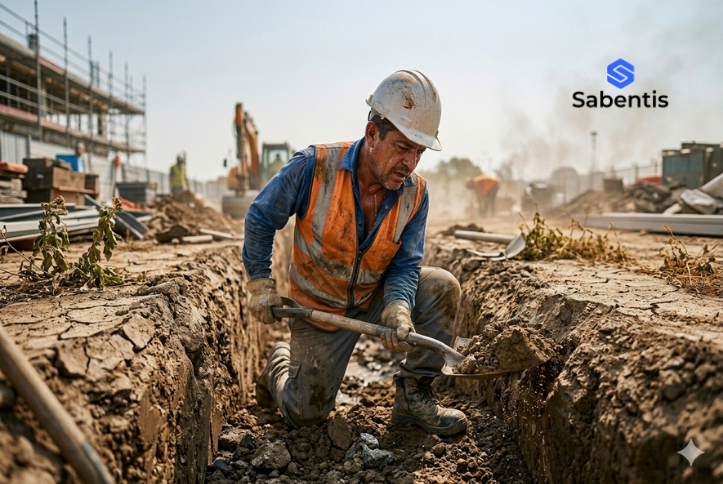
Climate change is no longer a future issue.
In fact, it is already directly impacting occupational health and safety (OHS), especially in the construction sector.
Moreover, heatwaves, extreme weather events, and changing environmental conditions are transforming how workplace risks are managed.
So, a key question arises:
👉 Are construction companies adapting their prevention strategies to this new reality?
🌍 How does climate change affect OHS in construction?
First of all, the construction sector is one of the most exposed. This is mainly due to: This is one reason construction continues to lead in workplace accidents.
- outdoor work
- direct exposure to weather conditions
- constantly changing environments
As a result, new risks are emerging.
☀️ More frequent heatwaves
For example: Studies show that heatwaves cause a sharp spike in workplace accidents.
- heat stress
- dehydration
- heat stroke
- reduced concentration
🌧️ Extreme weather events
In addition:
- heavy rainfall
- strong winds
- flooding
- unstable ground
🌫️ Air quality issues
On the other hand:
- higher levels of airborne particles
- increased exposure to pollutants
Consequently, the risk of accidents and occupational diseases increases. This makes strong accident prevention strategies more important than ever.
⚠️ The problem: OHS is not evolving at the same pace
However, many companies still rely on traditional approaches:
- static risk assessments
- limited updates based on weather conditions
- generic measures
- low traceability
Therefore, new risks are not properly managed.
🧩 What construction companies must do right now
In this context, adapting is no longer optional.
It is an operational necessity.
Here are the key actions 👇
1. Integrate climate risk into risk assessments
First, it is not enough to assess tasks.
Companies must also include:
- extreme temperatures
- solar exposure
- changing weather conditions
This leads to more accurate and useful assessments.
2. Implement specific preventive measures
For example:
- adjust working hours
- introduce mandatory breaks
- provide shaded areas
- ensure proper hydration
- use heat-adapted PPE
As a result, real risks are reduced.
3. Monitor conditions in real time
At the same time, weather conditions change constantly.
That is why companies need:
- updated data
- continuous monitoring
- fast response capability
4. Improve preventive planning
Finally, prevention must evolve.
It should now be:
- dynamic
- data-driven
- integrated into daily operations
🚧 The main challenge: from theory to real management
Even so, many companies struggle at this stage.
The issue is not knowing what to do, but how to do it:
- managing multiple sites
- coordinating teams
- ensuring compliance
- maintaining control
At this point, digitalization becomes essential.
💡 How an OHS platform helps manage these risks
Currently, many companies still rely on spreadsheets or isolated documents.
However, this is no longer enough.
An OHS platform allows companies to:
- centralize risk assessments
- manage multiple environments
- monitor preventive actions in real time
- coordinate teams and contractors
- ensure compliance and traceability
Therefore, it significantly improves preventive management.
🤖 The role of AI in climate-related prevention
In addition, technology is transforming prevention.
With solutions like Sabentis, companies can:
- analyze site images
- detect risks automatically
- assess real working conditions
- suggest corrective actions
- identify risk patterns
As a result, prevention becomes proactive.
👉 Moving from reactive to predictive, data-driven prevention.
📊 Real impact of advanced preventive management
As a result, companies achieve:
- ↓ 67% reduction in construction accidents
- ↓ 35% fewer recordable incidents in the first year
- ↓ 42% reduction in administrative workload
- x3 faster risk detection
🌱 OHS and climate change: a new way to prevent
In summary, climate change is reshaping OHS.
Now, it is not only about compliance.
It is also about:
- anticipating risks
- adapting in real time
- protecting workers
Therefore, companies that adapt early will lead the sector.
🚀 Want to adapt your OHS strategy to this new reality?
👉 Request a demo here:
https://www.sabentis.com/solicita-una-demo/
FAQ